
Audient Horizon: 127dB Input Dynamic Range Has Finally Arrived

Hi-fi enthusiasts chase playback quality; recording engineers chase input quality. The trouble is, input quality has barely moved in twenty years.
If you want a quick read on how good a converter really is, look at its dynamic range:
- Pro audio interface I/O dynamic range, 2006–2026:
| Year | Manufacturer | Model | Input dynamic range |
Input THD+N |
Output dynamic range |
|---|---|---|---|---|---|
| 2006 | Digidesign | 192 I/O | 120 dB @ +22 dBu |
−109 dB | 118 dB |
| 2011 | Apogee | Symphony I/O | 120 dB @ +24 dBu |
−113 dB | 129 dB |
| 2014 | RME | Fireface 802 | 116 dB @ +19 dBu |
−104 dB | 118 dB |
| 2016 | Apogee | Symphony I/O MK2 | 122 dB @ +24 dBu |
−114 dB | 126 dB |
| 2017 | Lynx | Aurora(n) | 119 dB @ +20 dBu |
−113 dB | 120 dB |
| 2018 | Universal Audio | Apollo x16 | 124 dB @ +24 dBu |
−115 dB | 133 dB |
| 2019 | Antelope | Orion 32+ Gen 3 | 121 dB @ +24 dBu |
−112 dB | 120 dB |
| 2020 | Prism Sound | Dream ADA-128 | 119 dB @ +24 dBu |
−111 dB | 125 dB |
| 2020 | Avid | Pro Tools | Carbon | 125 dB @ +24 dBu |
−113 dB | 120 dB |
| 2021 | Apogee | Symphony I/O MK2 SE | 124 dB @ +24 dBu |
−115 dB | 131 dB |
| 2021 | Lavry | Savitr | 128 dB @ +24 dBu |
−110 dB |
— A/D only |
| 2023 | Neumann | MT48 | 138 dB @ +24 dBu |
−105 dB | 123 dB |
| 2025 | Grace Design | m701 | 120 dB @ +24 dBu |
−108 dB | 125 dB |
Input dynamic range shown with each unit's maximum input level. Manufacturer specifications, compiled by Exound.
There's one obvious outlier: the Neumann MT48. Its input dynamic range is well ahead of anything else in its class, yet its THD+N is fairly ordinary.
That's because it combines several A/D converters running at different gain settings into a single channel. Every extra processing step adds distortion – which is exactly why the established interface makers have steered clear of this approach.
For now, the highest native A/D dynamic range belongs to the Lavry Savitr. It most likely reaches its sky-high figure by summing eight channels of an AKM AK5578 into one ("8-into-1").
Since the fire at AKM's plant choked off chip supply, the Savitr's price has crept all the way up to $8,600 – and that's without any D/A conversion at all. Not exactly within reach of the average engineer...
But silicon always moves on eventually, and last year ESS unveiled its new flagship ADCs: the ES9823PRO and ES9843PRO.
The ES9823PRO delivers 128dB of dynamic range straight out of the box (or more than 130dB when its two channels are run in parallel as a mono "2-into-1" converter). Thanks to that, the first audio interfaces built around it have now arrived —
- the Audient Horizon range (full details on Audient's own product page).

It isn't just the inputs, either. The output stage is just as current, using ESS's flagship ES9039PRO DAC with 132dB of output dynamic range.

The range comprises three models: the Horizon 8P, the Horizon 16 and the Horizon 32.
- If the name "8P" rings a bell... just put it next to UA's Apollo x8p.

Compared with the UA Apollo range, the key difference is that Horizon has no DSP effects processing.
You do still get a software mixer, of course.

Horizon also borrows one of the most useful features from Audient's ORIA: an immersive monitoring panel.
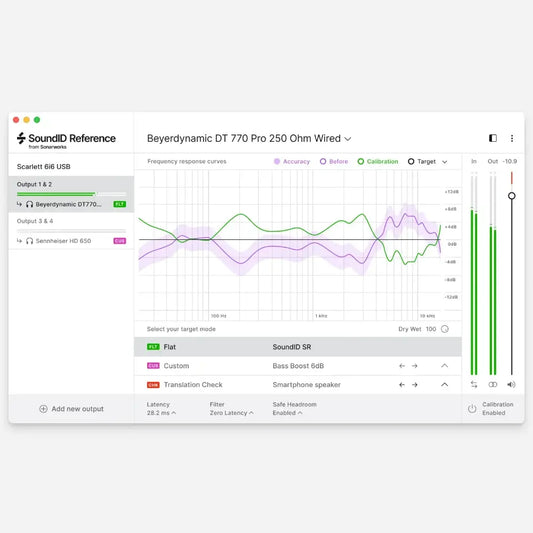
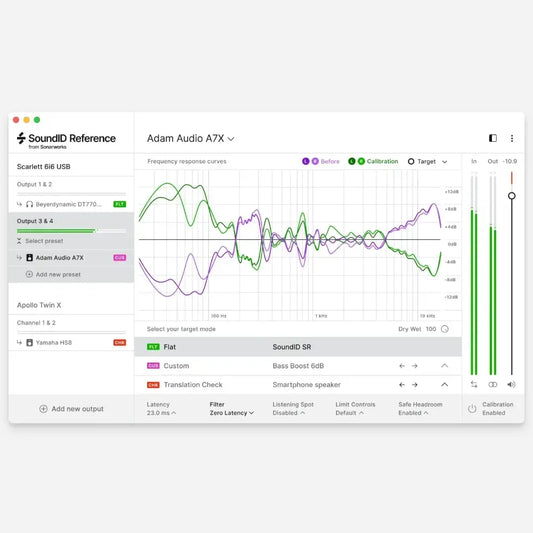
The difference is that in ORIA, clicking each speaker's little circle brings up an EQ panel, so you can tune every speaker individually (and even import SoundID calibration curves).
- Audient doesn't mention EQ anywhere for Horizon, and as far as I can tell from the manual, there isn't any.

Then there's the routing matrix you'd expect on any interface at this level. Up to four Horizon units can be daisy-chained and controlled from a single window.
The Horizon 32 offers 34 analogue inputs and 34 analogue outputs, so chain four together and you can record 34 × 4 = 136 analogue inputs (200 × 200 in total once you add the ADAT channels)... A full symphony orchestra won't trouble it.

On the input side there's a rather fun feature: high/mid/low impedance switching, which Audient calls ORBIT Control.
It's a genuine hardware change (relay-switched between 2.8kΩ, 1.2kΩ and 220Ω), not a software trick, and it subtly shifts the character of your microphone.
- That said, if you know your UA kit... physically variable preamp impedance was one of the features Apollo pioneered – Unison arrived more than a decade ago.

Apollo does have one small problem, though... its latency is on the high side.
To be fair, any interface with onboard DSP effects tends to carry a little more latency, Apogee included. But because Apollo still relies on older SHARC DSP chips (built on a 90nm process), its latency is higher still – worse, in fact, than some low-latency USB interfaces such as those from MOTU and RME.
Horizon's latency, on the other hand, is excellent: 0.99ms round trip (input + output). Then again... it doesn't have any DSP effects to deal with...

So just how low is that? Let's compare it with the MOTU UltraLite-mk5 under the same conditions.
The mk5 is one of the lowest-latency USB interfaces we've ever tested. Yet at Audient's test settings (192kHz, 64-sample buffer, round trip), it can only manage 1.4ms.
- It seems USB still can't quite keep pace with Thunderbolt...

That just about covers the headline features...
- Here's the full spec comparison:
| Audient Horizon 8P |
Audient Horizon 16 |
Audient Horizon 32 |
|
|---|---|---|---|
| Preamps | |||
| Mic preamps | 8 +75 dB gain |
— | — |
| Instrument inputs | 2 JFET, +75 dB gain |
— | — |
| Preamp impedance | 3-position ORBIT 2.8k / 1.2k / 220 Ω |
— | — |
| DB25 line inputs | 8 switchable per channel with mic inputs |
— | — |
| Inputs & Outputs | |||
| Total I/O (incl. ADAT) | 24 in / 32 out | 34 in / 34 out | 50 in / 50 out |
| Analogue line inputs | 8 127 dB dynamic range |
18 16 DB25 + stereo mix bus, 127 dB |
34 32 DB25 + stereo mix bus, 127 dB |
| Analogue outputs | 12 8 DB25 + 2 speaker pairs, 132 dB |
18 16 DB25 + stereo monitor, 132 dB |
34 32 DB25 + stereo monitor, 132 dB |
| Headphone outputs | 2 124 dB / +15 dBu |
— | — |
| Digital I/O | 2 × ADAT in / 2 × ADAT out + BNC word clock I/O | ||
| Reference level | Selectable +18 dBu / +24 dBu | ||
| Software & Control | |||
| Control software | Horizon Control software mixer + immersive monitoring panel | ||
| Operation | Hardware or software | Mainly via the software mixer | |
| Monitoring | Mute, Dim, Mono, Polarity, M/S, talkback, routing matrix… | ||
| Round-trip latency | 0.99 ms (192 kHz / 64-sample buffer) | ||
| Computer connection | Dual Thunderbolt 3 · daisy-chain up to four Horizon units (200 × 200 max) | ||
| OS support | macOS only | ||
| Build & Pricing | |||
| Bundled software | ARC software bundle (Cubase LE, Softube, SoundID…) | ||
| Net weight | 4.15 kg | 4.05 kg | 4.4 kg |
| Dimensions (W/H/D) | 483 / 44.5 / 330 mm (1U rackmount, fanless) | ||
| Warranty | 3 years | ||
| UK street price Thomann UK |
£2,111 | £2,111 | £2,799 |
| EU street price Thomann Germany |
€2,489 | €2,489 | €3,289 |
| US street price Sweetwater |
$3,499.99 | $3,499.99 | $4,299.99 |
So how does Horizon stack up against Apollo on price? Here in the UK and across Europe, the answer is: very well indeed.
- Horizon vs Apollo X Gen 2 at Thomann (inc. VAT):
| Audient Horizon | UA Apollo X Gen 2 | Horizon saving | |
|---|---|---|---|
| 8 mic preamps | Horizon 8P £2,111 €2,489 |
Apollo x8p £2,848 €3,299 |
£737 €810 |
| 16 channels of line I/O | Horizon 16 £2,111 €2,489 |
Apollo x16 £3,111 €3,599 |
£1,000 €1,110 |
| Largest line-level model | Horizon 32 £2,799 €3,289 32 DB25 channels |
Apollo x16 £3,111 €3,599 16 DB25 channels |
£312 €310 with twice the channels |
GBP prices from Thomann UK, EUR prices from Thomann Germany, both checked October 2026. Apollo prices are for the Gen 2 AC editions with the UAD Analog Classics bundle – the same edition Sweetwater lists in the US.
That's a gap of up to £1,000 (or €1,110) between like-for-like models – and with the Horizon 32, you get twice the analogue I/O for less money.
Cross the Atlantic, though, and it's a different story entirely.
In North America – the world's biggest market for studio gear – Horizon's street prices sit well above Audient's own announced US pricing ($2,799 for the 8P and 16, $3,499 for the 32). At Sweetwater, the 8P and 16 are currently listed at $3,499.99, and the 32 at $4,299.99.
And then... Apollo suddenly got cheaper...
- So at Sweetwater, the Apollo x8p (now $3,399) actually comes in $100 under the Horizon 8P...

That said, the two ranges don't really go head-to-head.
Apollo also comes as the x6 (two preamps) and the x8 (four preamps), but there's no "x32". If you need lots of analogue channels, the Horizon 32 is your only option here.
The other point is this: Apollo's big selling point is obviously its DSP – but when it comes down to it, do you actually need DSP effects?
- If you're shopping for an interface at this price, chances are you already own a fair bit of outboard – hardware preamps, compressors and EQs – so you've little need for software emulations of them...
- If you rely on plug-ins from Waves, iZotope or FabFilter, none of them can run on Apollo's DSP anyway – and only a handful of Softube titles were ever ported to UAD...
- If you're devoted to a particular UA plug-in, most of them are now available in Native versions that run on your computer's CPU...
But if Horizon has caught your eye, there's one thing you need to be very aware of:
- It doesn't support Windows.

PS: UA officially says its Thunderbolt Apollo interfaces support Windows, but trust me – whatever you do, don't run them on Windows...