
IK ARC Studio+: Room Correction That's (Almost) an Audio Interface

When the Audient ORIA mini came out, we lined it up against IK Multimedia's ARC Studio and took the chance to air a few gripes about the latter.
One of them:
- No digital input.
That means the signal coming off your audio interface's D/A has to go through another round of A/D and D/A inside the ARC Studio. And since most studio monitors these days are DSP-based, there's yet another A/D the moment the signal reaches the speaker...
Every one of those extra stages is another chance for conversion losses to creep in.

Well, IK has a digital input now too. Meet the ARC Studio+.
That little "+" is easy to miss, so feel free to call it the "ARC Studio Plus". On top of optical S/PDIF in and out, the USB-C port now carries audio as well. It adds a dedicated measurement-mic input, plus calibration no longer even needs a computer...
- ...and you could almost call it an audio interface.
Almost. The USB-C connection is a digital input for playback, and the XLR socket is reserved for the ARC measurement mic so that it won't be recording your vocals any time soon. Think of it as a USB DAC with room correction built in.
Worth noting: on the original ARC Studio, the USB-C port only handled control data and carried no audio at all. The same goes for the USB-C port on the ORIA mini.

The ARC Studio+ has also picked up quite a few ideas from the ORIA mini, starting with:
- A dedicated SUB output
So it can now handle bass management as well. According to IK, crossover, phase, delay and level for the sub are all aligned automatically during calibration.

It has also borrowed the ORIA mini's scene switching:
- Three scenes, recalled straight from the front panel.
Each scene stores the calibration profile, speaker routing, sub on/off and input selection, so you could have one for the mix position, one for a wider listening area and one for the sofa at the back.


The disappointment? The conversion hasn't moved on. IK still quotes 120dB(A) dynamic range in and out, exactly as before.
If you're running a thousand-pound-class interface with 125dB or more of output dynamic range, you probably don't fancy squeezing it back down to 120dB on the analogue route...

The pricing is pretty fair, mind. Here in the UK, Thomann currently lists the ARC Studio+ at £339, the same money as the ORIA mini + SoundID Reference bundle. Cross the Atlantic, and it's just $100 more than the ARC Studio ($399.99 vs $299.99, at IK's introductory price), which puts it right alongside the ORIA mini.
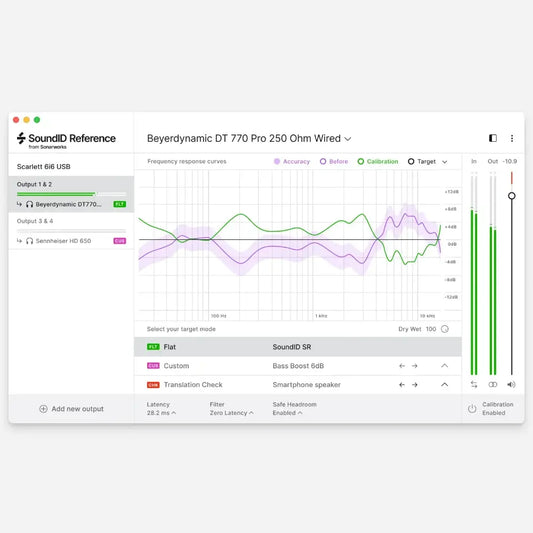
Bear in mind that both ARC Studio models include the ARC X calibration software, whereas the bare-bones, hardware-only ORIA mini ($299 / £249) doesn't come with SoundID.
- If you want USB-C playback, the ARC Studio+ is worth a look.
- If you've got a pro interface with more than 125dB of output dynamic range, the ORIA mini, with its wider dynamic range, is our pick.

- Here's how the three hardware calibration processors compare:
| Audient ORIA mini |
IK Multimedia ARC Studio |
IK Multimedia ARC Studio+ |
|
|---|---|---|---|
| General | |||
| Released | Sep 2025 | Feb 2024 | Oct 2026 |
| Conversion | |||
| Dynamic range | 122.5dB analogue in → out 127dB optical in → analogue out |
120dB(A) in / out |
|
| Analogue I/O | |||
| Line I/O | TRS 2 in / 2 out |
XLR 2 in / 2 out |
XLR 2 in (XLR/TRS combo) / 2 out |
| Measurement mic input | XLR | — | XLR ARC MIC |
| Sub output | TRS | — | TRS |
| Digital I/O | |||
| Optical | S/PDIF input only |
— | S/PDIF in / out |
| USB-C audio |
— power & control only |
— control only |
Yes digital input, up to 192kHz |
| Calibration & control | |||
| Bass management | Adjustable crossover | — | Yes auto-aligned during calibration |
| Calibration software | SoundID Reference bundle version only |
ARC X included | |
| Calibrate without a computer | — | — | Yes 1- or 3-point |
| Front-panel presets | Profile switching |
— correction on/off only |
3 scenes |
| Bonus software | Audient ARC bundle Cubase LE, Softube mastering, AXXESS synth, Output Arcade sounds, Strymon BigSky reverb, Spitfire organ… |
— | |
| Price | |||
| UK street price Thomann UK, inc. VAT |
£339 with SoundID (hardware only: £249) |
£209 | £339 |
| EU street price Thomann DE, inc. VAT |
€403 with SoundID |
€247 | €399 |
| US price excl. sales tax |
$299 hardware only $449 with SoundID |
$299.99 | $399.99 intro price, then $449.99 |
Manufacturer specifications; prices checked October 2026 and subject to change. Note that Audient's "ARC" is its bonus software bundle, nothing to do with IK's ARC. Compiled by Exound.
One last thing. When we took the ORIA mini apart, we spotted some suspiciously tidy empty spaces on its circuit board.
By rights, that suggests a "higher-end" version is on the way, with at least two more inputs and a headphone amp. If you're not in a hurry, it might be worth hanging on a little longer...